UNIPMA Turns Coconut Husk Waste into Economically Valuable Products in Ponorogo
UNIPMA — Lecturers from Universitas PGRI Madiun (UNIPMA) have provided a solution for managing coconut husk waste in Tulung Village, Sampung District, Ponorogo Regency. The waste, which has previously been piled up or burned, is processed into cocopeat and cocofiber using appropriate technology.
The waste problem has emerged alongside the increasing tourism activity in Sampung District. The growing number of young coconut vendors in tourist areas has resulted in a larger volume of coconut husk waste, while its management has not yet been optimized.
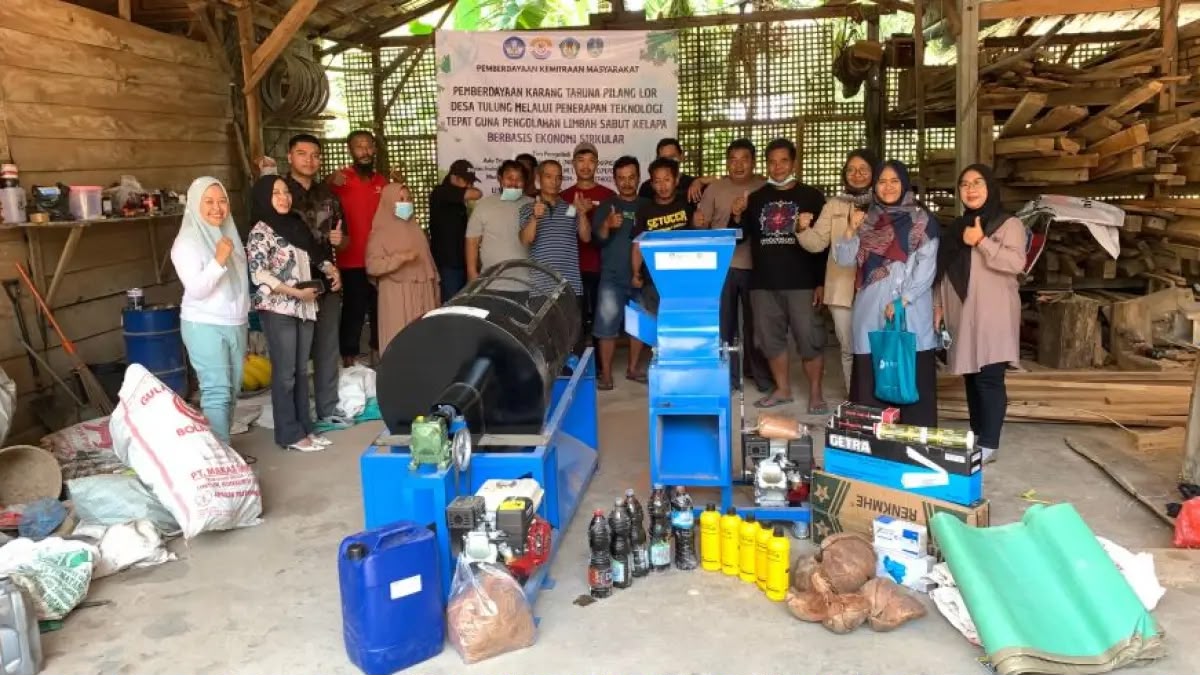
The UNIPMA team then assisted Karang Taruna Pilang Lor, Tulung Village, in transforming the waste into reusable materials. The approach adopted was based on the principles of a circular economy, namely reprocessing waste so that it can have a new function and economic value.
The UNIPMA community service team consisted of Ade Trisnawati, S.Pd., M.Pd., as team leader; Dyan Hatining Ayu Sudarni, S.ST., M.T., from the Chemical Engineering Study Program; and Metik Asmike, S.E., M.M., from the Management Study Program as faculty members. Two students from the Chemical Engineering Study Program, Achmad Zaky Afif Mukhorobin and Lutfia Lailatus Sa'adah, also participated in the activity.
In an interview, Ade Trisnawati, S.Pd., M.Pd., said that the waste problem could not be solved simply by providing waste-processing equipment. The community also needs to have the knowledge and skills to manage waste sustainably.
“Technology needs to be accompanied by skills and organizational strengthening so that waste management can be carried out independently,” said Ade Trisnawati, S.Pd., M.Pd., on Tuesday (22/9).
The assistance was provided to 10 active participants from Karang Taruna Pilang Lor. They received training on youth organization management, coconut husk waste management, environmental chemistry, circular economy principles, and the use of appropriate technology equipment.
In practice, participants learned the stages of processing coconut husks into ready-to-use cocopeat and cocofiber. The activities were carried out through face-to-face sessions, discussions, and hands-on practice so that the skills provided went beyond theoretical understanding.
For Ade Trisnawati, S.Pd., M.Pd., processing coconut husks into cocopeat and cocofiber is an initial step toward developing productive activities based on local resources. Therefore, Karang Taruna is also encouraged to establish a management system capable of supporting the activities after the assistance program ends.
“Karang Taruna is expected not only to be able to process coconut husks, but also to develop the products into a productive business unit,” she added.
The development of these activities is expected to provide a new source of income for Karang Taruna and Tulung Village. The village government is also expected to become involved so that waste management and business development can be integrated into the village’s agenda.
This assistance program is part of the Community Partnership Empowerment Scheme funded by DPPM RISBANG KEMDIKTISAINTEK in 2026. The activity has been running for eight months since April 2026 and is still ongoing.