NEUST Philippines Hosts UNIPMA Management Lecturer to Discuss Indonesia’s Monetary and Fiscal Policies
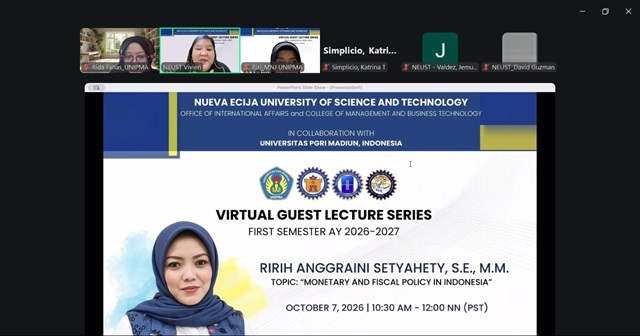
UNIPMA — Ririh Anggraini Setyahety, S.E., M.M., a lecturer from the Management Study Program, Faculty of Economics and Business (FEB), Universitas PGRI Madiun (UNIPMA), was invited as a speaker for the Guest Lecture Series organized by the College of Management and Business Technology, Nueva Ecija University of Science and Technology (NEUST), Philippines, on Wednesday, October 7.
During the virtual guest lecture, attended by academic communities from both universities, Ririh Anggraini Setyahety, S.E., M.M., delivered a presentation entitled “Monetary and Fiscal Policy in Indonesia: Framework, Instruments, and Policy Coordination for Economic Stability and Growth.” She explained how the Indonesian government and central bank manage the national economy amid global economic dynamics.
Ririh Anggraini Setyahety, S.E., M.M., explained that Indonesia’s economic management relies on the synergy of two main policy instruments. The first is monetary policy, implemented by Bank Indonesia through several instruments, including the BI-Rate benchmark interest rate, open market operations, exchange rate interventions, liquidity management, and macroprudential policies to maintain price stability and financial system resilience.
The second is fiscal policy, managed by the Ministry of Finance through the State Budget (Anggaran Pendapatan dan Belanja Negara/APBN), which covers state revenue, central government expenditure, transfers to regional governments, and financing.
She emphasized the importance of close coordination between these two policies in addressing various challenges, including the macroeconomic trilemma of maintaining exchange rate stability, capital mobility, and monetary policy independence.
“Synergy between the government and the central bank is essential to ensure that the policies implemented complement and support one another, particularly when addressing global economic pressures and uncertainties,” she stated on Thursday, October 29.
Furthermore, the presentation connected macroeconomic concepts with the business world. Changes in interest rates, exchange rates, and fiscal policies were highlighted as factors that directly affect the cost of capital, investment decisions, cash flow, and corporate competitiveness.
“In the field of management, understanding these aspects is important because changes in these factors influence business strategies and corporate decision-making,” she added.
Through this activity, students gained a comprehensive understanding of the integration between macroeconomic theory and management practices. The Guest Lecture also served as a platform for exchanging academic perspectives across countries and implementing the Three Pillars of Higher Education (Tridharma Perguruan Tinggi) on the international stage.